Red Grapevine for Heavy Legs and Thread Veins: How Many Drops, and Why Taking It Only in Summer Is a Mistake
 di Bianca Ioppolo · 2026-08-03 · 6 min
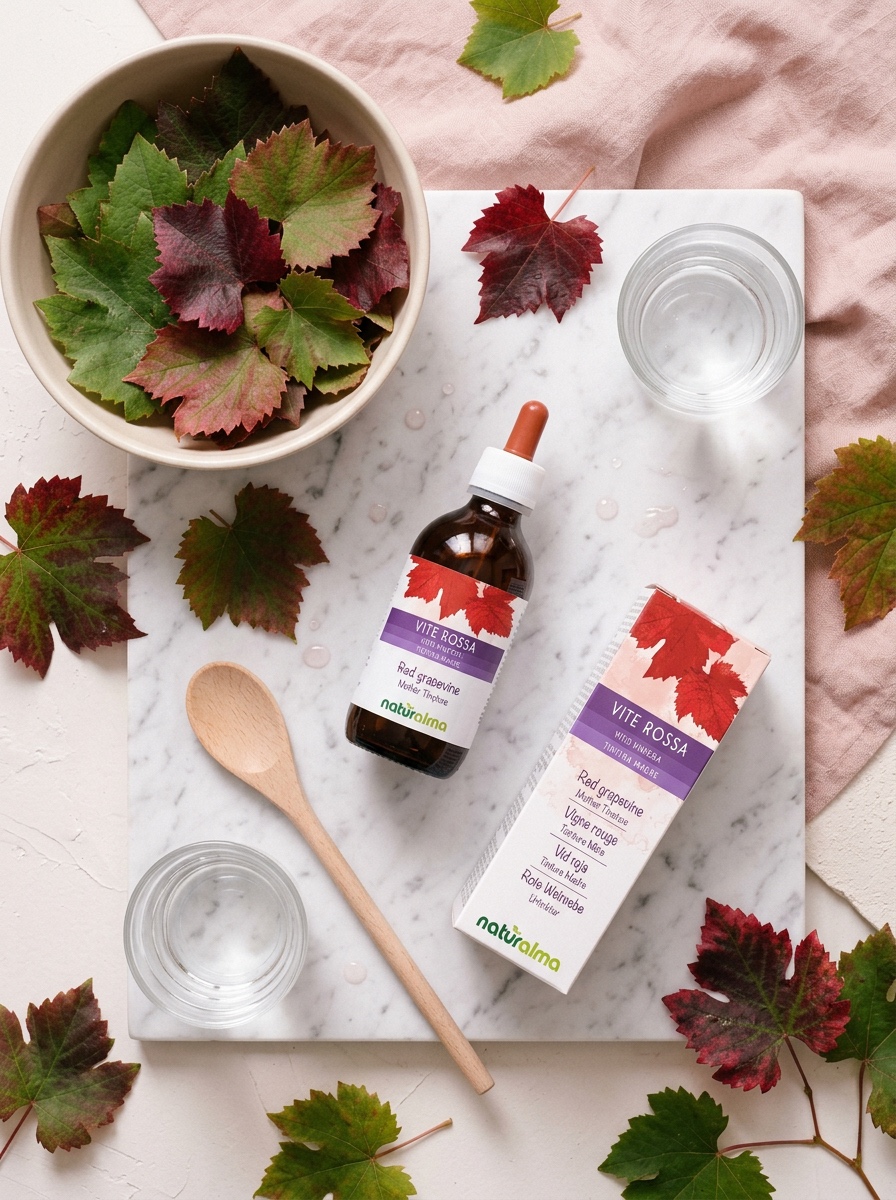
Do you look down at your ankles at the end of the day and see those little red threads?
Small, fine, reddish. Behind the knee, around the ankles, sometimes on the thighs. They don't hurt, but you can see them. And you look at them and think: where on earth did those come from?
Then there's the classic scene. You get in, kick off your shoes and your legs are throbbing. Your ankle is rounder than it was this morning. Your toes feel puffy. Whether you've spent eight hours on your feet or eight hours at a desk, the outcome is the same: the blood making its way back up has been working uphill all day.
There's one plant that European tradition has used for centuries for exactly this. And the lovely part is that you already have it in the house, in a form you drink at Christmas. But first, something almost nobody knows: the time of year you take it matters more than the dose. I'll explain that in part three, so don't wander off.
Want to know which plant I mean? It's the red wine one
I'm talking about red grapevine, botanical name Vitis vinifera. Yes, the grape vine. Except here we're not interested in the fruit for wine: we're interested in the leaves, the ones that turn fiery red in autumn. That colour isn't an accident.
That red comes from anthocyanins, natural pigments. Alongside them, the leaves carry polyphenols. These are the two families of compounds behind all the interest in this plant: research has singled them out precisely for their role in the smallest vessels, the very fine ones, the capillaries.
Picture the microcirculation as a network of very thin tubes. If the walls are elastic and holding well, fluid stays where it belongs. If the wall gets a bit slack, fluid seeps out, pools in the tissues, and you end up with a puffy ankle and sock marks at seven in the evening. Red grapevine is traditionally used to support the tone of that network and help the body drain excess fluid.
In European folk medicine the leaves went into decoctions for foot baths and compresses on tired legs. The macerate was used as an astringent. Red grapevine was said to "strengthen" the vessels, and to be a friend to sensitive facial skin, the kind that flushes easily. These days we take it by mouth, in drops, which is far more convenient than boiling up leaves.
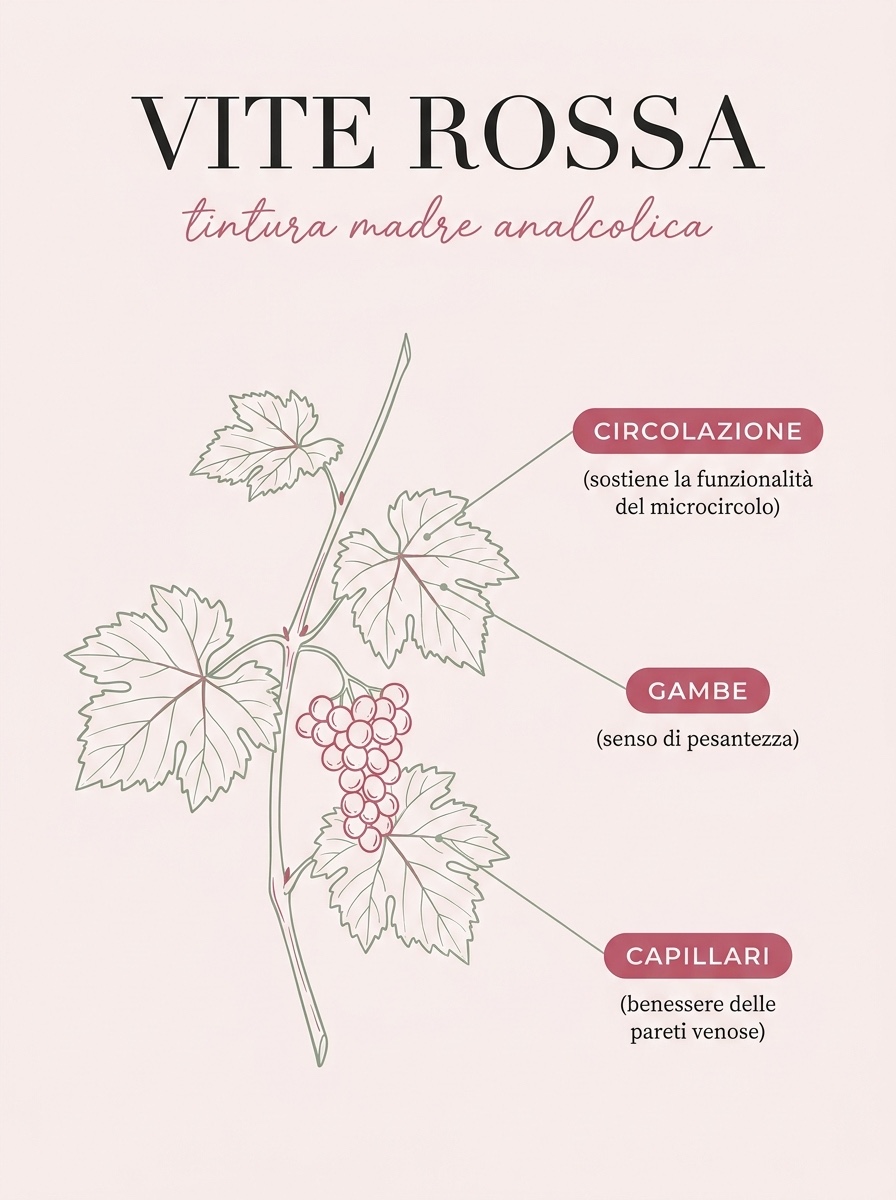
And now the part you actually came for: why it isn't just a summer thing
Here's the mistake. Most people buy red grapevine in June, use it through July and August because warm weather makes their legs swell more, then pop it in the bathroom cupboard in September and forget all about it.
Warmth does make the feeling worse, that's true: vessels dilate and the swelling registers more strongly. You notice it on the first properly muggy week of the year, or on a stuffy commute. But your microcirculation doesn't go on holiday in October. If you're on your feet all day, if you work sitting down, if you do a lot of long journeys and flights, if heavy legs run in the family, this is a twelve-months-a-year topic.
So here's how I'd think about red grapevine: cycles of 6–8 weeks, repeated 2 or 3 times a year. One in spring, when you fancy getting yourself back in order anyway and you're probably already eating a bit lighter. One before or during the warm months. And one in autumn, which is the most underrated of the lot.
Another small but very common mistake: taking 40 drops once, every other day, and expecting a miracle. Plants work through consistency, not through big gestures. Far better 40 drops every day for two months than 120 drops taken three times during one enthusiastic week.
How many drops, when, and for how long (the real numbers)
The method couldn't be simpler. 40 drops, which is 2 ml, diluted in a glass of water. One to three times a day, at any time of day. So you're looking at 40 to 120 drops a day in total. Those 40 drops contain 200 mg of red grapevine.
How do you actually organise it? If you're starting now and have never taken anything like this, begin with 40 drops a day, every day, and see how you get on. If the heaviness is strong and it's with you from the morning onwards, you can move up to 40 drops twice a day, say one at breakfast and one in the afternoon. Three doses is the maximum. Don't exceed the recommended daily dose: more isn't better.
The glass of water isn't just for show: it softens the taste, which is green and a little astringent, and it reminds you to drink. Because you can take all the drops in the world, but if you're getting through two glasses of water a day you're working against yourself.
It comes in three sizes: 60 ml, 120 ml and 200 ml. The 60 ml is the try-it-out one, roughly a month at 40 drops a day. The 120 ml is the most sensible choice if you want a full two-month cycle. The 200 ml makes sense if you already use it and know you'll come back to it. And one thing worth saying plainly: the Naturalma mother tincture is alcohol-free, so the taste is gentle and you're not adding anything you'd rather avoid — as always, have a read of the label of the size you choose.
And how long before you feel anything? Honestly: on the lighter-legs feeling, people tend to report a change after 2–3 weeks of daily use, and it's not fireworks, it's that "hang on, no sock marks tonight" you notice almost by accident. For the look of the skin and visible veins it takes far more patience, and results vary a lot from person to person. If someone promises to make it all disappear in a week, they're not telling you the truth.
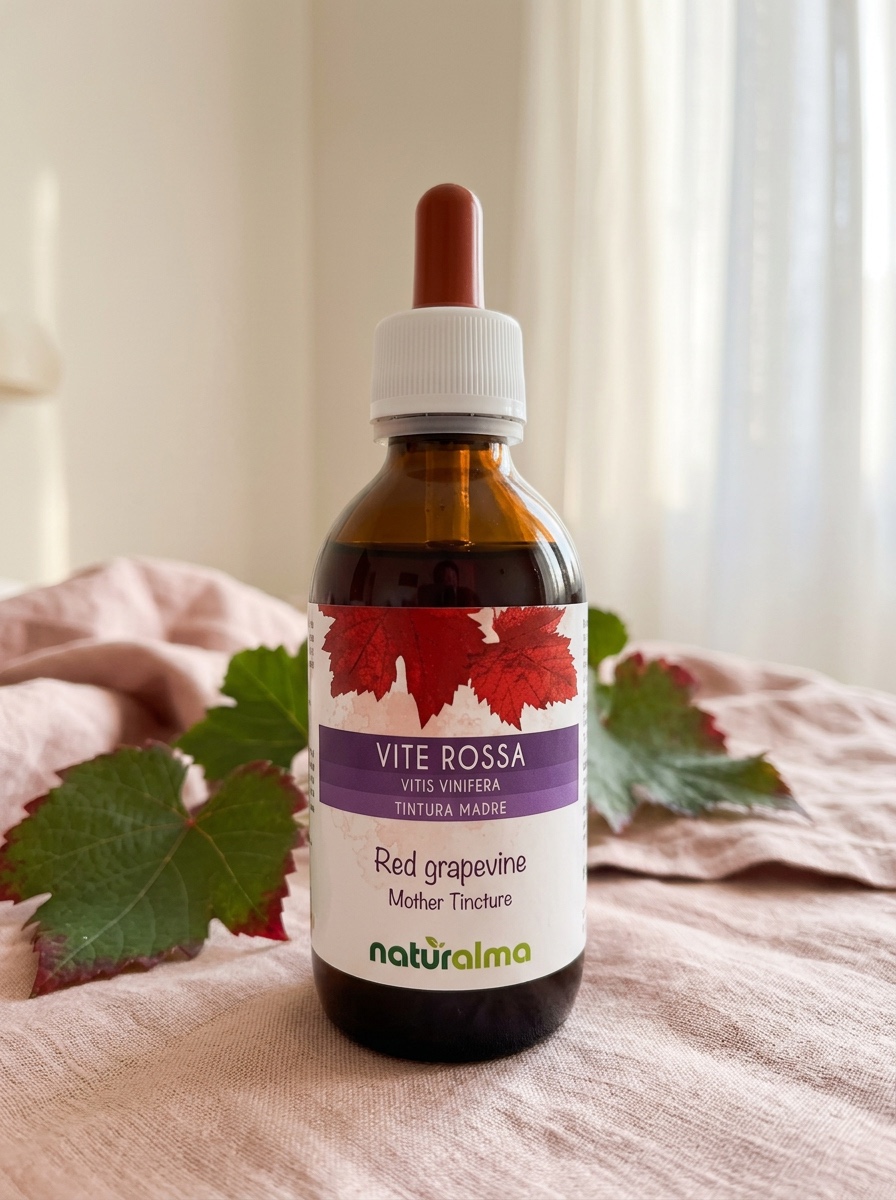
One word of caution: who should check with a doctor first, and what pairs well with it
As I always say, I'm not a doctor. So: if you're pregnant or breastfeeding, or if you take medication — particularly anything that affects how your blood thins — have a word with your GP or pharmacist first. Same goes if you've got surgery booked in. Keep the product out of reach of children.
And if the swelling is significant, if it's in one leg only, if there's pain or the skin changes colour, this isn't the moment for drops: it's the moment to get seen. If the problem carries on, talk to your doctor. A supplement supports everyday wellbeing, it doesn't replace an appointment.
What does it go with? Red grapevine works happily alongside gotu kola (Centella asiatica): they're the two classic companions for leg comfort, and plenty of people alternate them in cycles or use them together. If you do, stick to the recommended dose of each and don't improvise.
Then there are the three habits worth more than any bottle, in order of importance. One: drink — at least a litre and a half a day. Two: walk twenty minutes a day, because the calf is the pump that pushes blood back up. Three: in the evening, ten minutes with your legs up against the wall. Costs nothing and you feel it.
Now tell me something: are your legs only heavy in summer, or right now too? Let me know in the comments, I'm genuinely curious how many of you deal with it all year round. And if you fancy trying red grapevine, you'll find it in the shop in whichever size suits you. Take care!
How many drops of red grapevine should I take a day?
40 drops (2 ml) diluted in a glass of water, one to three times a day: so 40 to 120 drops in total across the day. If you're starting from scratch, begin with 40 drops a day and see how you feel after a couple of weeks. Don't exceed the recommended daily dose.
Is it better in the morning or in the evening?
The label says "at any time of day", so there's no fixed slot. If you're taking one dose, pick the time you'll remember most easily: consistency matters more than the clock. If you're taking two, split them between morning and afternoon.
How long can I take it for?
The most sensible approach is cycles of 6–8 weeks, repeated 2 or 3 times a year. One cycle in spring, one over the warm months and one in autumn, which is the one nearly everyone forgets. If you'd like to take it continuously for longer, check with your doctor first.
How long before I notice anything?
On the feeling of lighter legs, most people report a change after 2–3 weeks of daily use. For the look of the skin and visible veins it takes considerably longer and results are very individual. No plant makes anything vanish in seven days.
What's the difference between the 60, 120 and 200 ml bottles?
Only the amount of product, not the formulation. The 60 ml covers roughly a month at 40 drops a day and is ideal for trying it. The 120 ml takes you through a full two-month cycle. The 200 ml makes sense if you already use it regularly or if two of you are taking it.
Who shouldn't take it?
If you're pregnant or breastfeeding, if you're on medication — especially anything affecting how your blood thins — or if you have surgery coming up, speak to your doctor first. Keep the product out of reach of children. The mother tincture is alcohol-free, but always read the label of the size you choose.
Can I take red grapevine together with gotu kola (Centella asiatica)?
Yes, they're the two plants traditionally paired when the subject is legs and microcirculation, and many people alternate them in cycles or use them together. Stick to the recommended dose of each and, if you're already taking other supplements or medicines, run it past your pharmacist.
 Vite rossa — Tintura madre Naturalma
search “red grapevine” on naturalma.it
RED GRAPEVINE Alcohol-free mother tincture 120 ml Naturalma on Amazon
or search “red grapevine naturalma” on Amazon
Vite rossa — Tintura madre Naturalma
search “red grapevine” on naturalma.it
RED GRAPEVINE Alcohol-free mother tincture 120 ml Naturalma on Amazon
or search “red grapevine naturalma” on Amazon
 Bloating, restless nights and constant sugar cravings?59 sec
 That burning feeling that creeps up after meals just won't quit?45 sec
 Stage 3 cellulite?99 sec
 My routine for a lighter, less bloated tummy, from breakfast to after dinner142 sec
Royal Jelly: Not Coffee, and Not Judged in Three Days
Royal jelly mother tincture: 40 drops (2 ml) give you 400 mg, one to three times a day. When to take it, how long for, and whether to pick 60 or 120 ml.
Keep reading
Pine Bach Flower: How Many Times Did You Say Sorry Today?
Pine is the Bach flower for people who apologise for everything, even when it isn't their fault. How many drops, when to take them and which 30 ml bottle to pick.
Keep reading